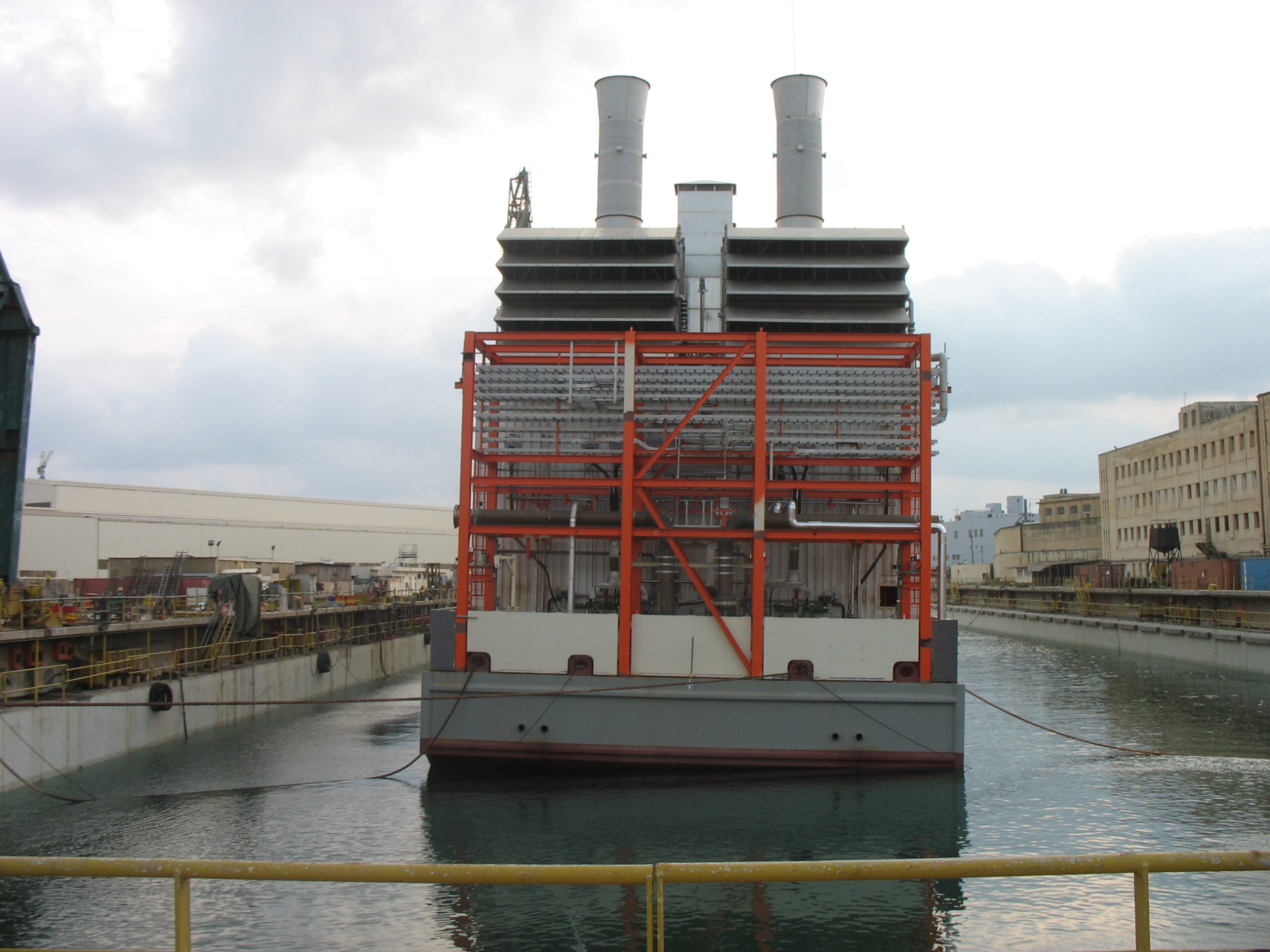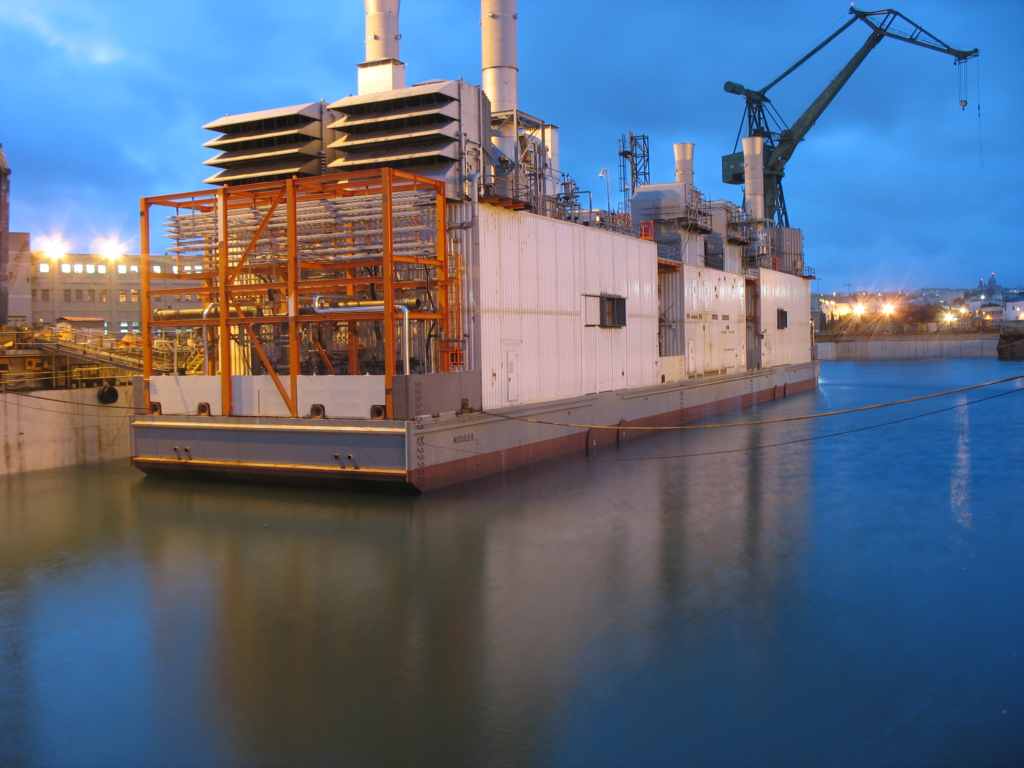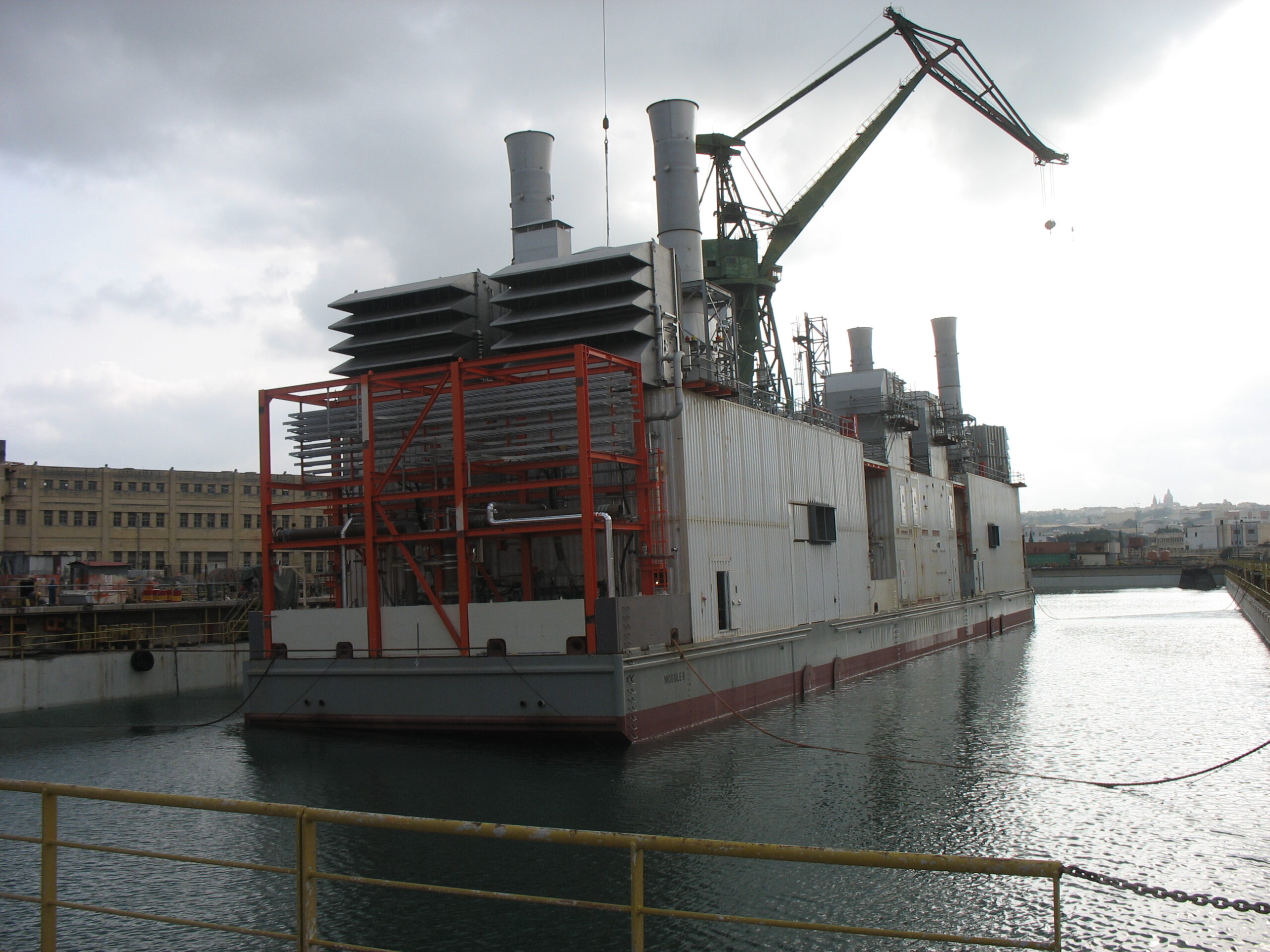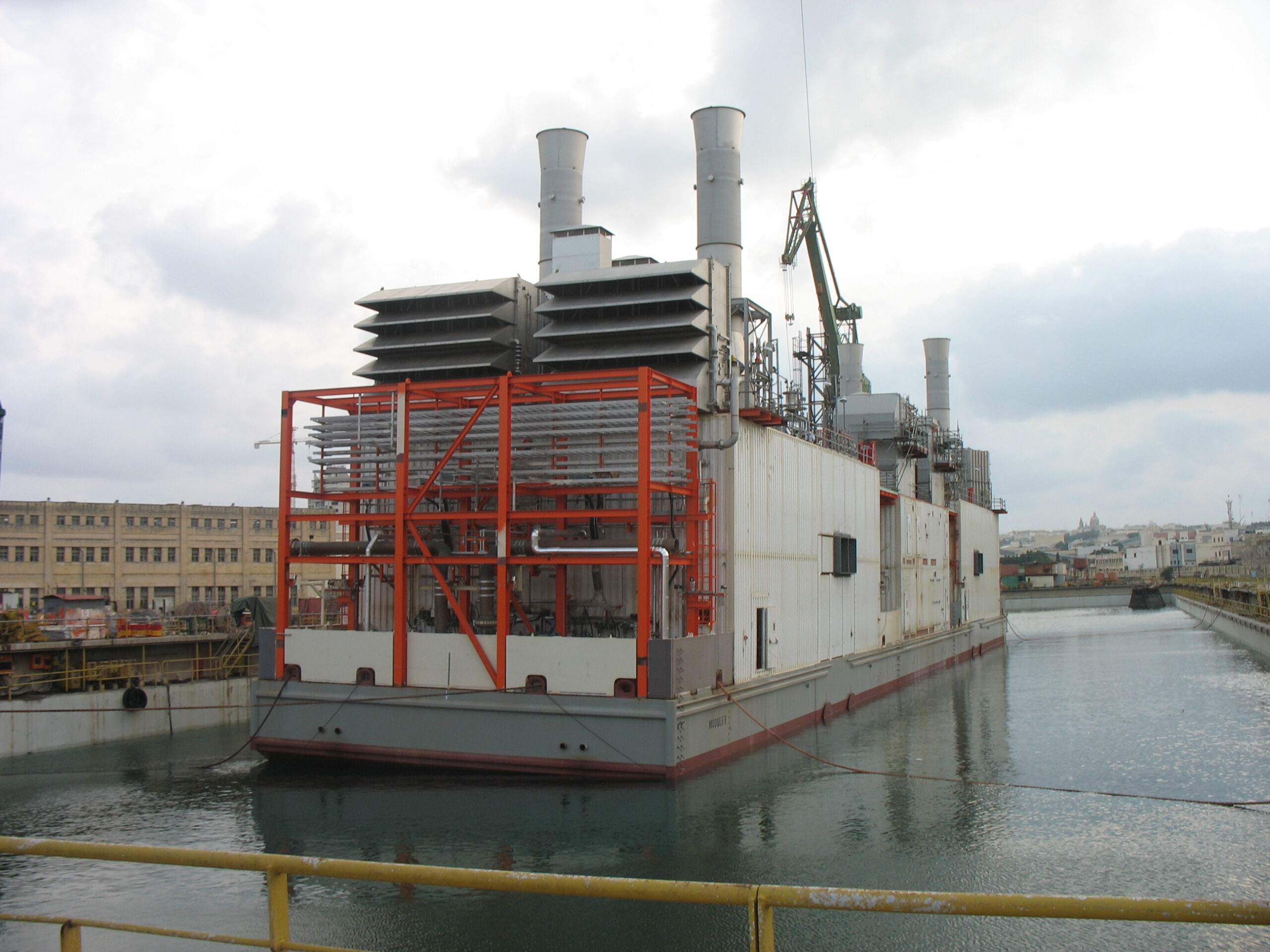
Power Generation Barge 8 represents a landmark engineering achievement in offshore power generation infrastructure. Commissioned by AGIP Kashagan and executed through the ABB-Rolls Royce Joint Venture, this specialized facility delivers critical electrical power to the Kashagan Field Development Experimental Program in the challenging environment of the North Caspian Sea.
TECON provided comprehensive structural engineering services, encompassing the detailed design of the barge’s structural systems to withstand both the demanding towing journey from Malta through multiple seas and waterways, as well as the permanent installation conditions in approximately 8 meters of water depth near artificial island D.
The barge serves as a floating power station, carrying two main stick-built modules that each house two 30 MW gas turbine generators with their associated auxiliary systems. Each turbogenerator comprises one RT62 Power Turbine and one RB211-DLE gas turbine, both manufactured by Rolls Royce. A third stick-built module accommodates all switchgear and control room facilities designed and supplied by ABB, providing centralized power distribution and operational control for the entire facility.
The project presented unique engineering challenges requiring dual-phase structural design. The barge was constructed in a dry dock facility in Malta, where it was fully outfitted with all power generation and distribution equipment before embarking on an extraordinary journey. The vessel was towed through the Mediterranean Sea, Black Sea, Sea of Azov, Don River, Lenin Canal, and Volga River before reaching the Caspian Sea—a route demanding exceptional structural integrity and seaworthiness.
Upon arrival at the installation site, the barge underwent a sophisticated lifting operation using strand jacks positioned atop four pre-installed foundation piles. Following precise vertical positioning, the barge was permanently connected to these piles through specially designed shear plates welded to the barge sides, deck, and bottom, transforming the mobile structure into a fixed offshore platform.
TECON’s scope of work encompassed comprehensive structural analysis and design for both operational phases, applying appropriate design codes for each condition: Russian Register standards for unmanned towed barges during navigation, and API fixed platform design codes for the permanent installation configuration.
The lifting operation required innovative engineering solutions. TECON designed a system utilizing large-diameter pipes that could be hydraulically extended from the barge sides to serve as lifting bollards during the strand jack operation, then retracted using the same hydraulic jacks once the permanent pile connections were completed. This approach demanded sophisticated FEM analysis with solid elements to ensure structural integrity during the critical lifting phase.
Recognizing that the installed barge would share foundation piles with other similar power generation units, TECON developed a comprehensive combined structural model featuring five side-by-side barges. This advanced modeling approach enabled accurate dynamic response prediction and fatigue life assessment, accounting for the interaction effects between adjacent structures—a critical consideration for long-term structural reliability in the shared foundation configuration.